Sacred Festivals
Jain festivals do not ask the heavens for favours — they turn inward. Their feasting is fasting, their fireworks are forgiveness, and their grandest procession is the soul's walk home.
Mahavir Janma Kalyanak (Mahavir Jayanti)
Chaitra Shukla 13 — March / April
The birth of the Great Hero at Kshatriyakund. Images of the infant Tirthankara are carried in procession and ceremonially lustrated, recalling Indra's bathing of the newborn on Mount Meru. Queen Trishala's auspicious dreams are recited and re-enacted, and the day is marked with charity, prayer and acts of kindness to animals — the truest birthday gift to the apostle of ahimsa.
Akshaya Tritiya
Vaishakha Shukla 3 — April / May
The “undecaying third” remembers the first alms ever given to an ascetic in our age: after a year-long fast, the first Tirthankara Rishabhanatha received sugarcane juice from Prince Shreyans at Hastinapur. Jains who complete the alternate-day varshi-tap fast break it on this day with sugarcane juice, honouring the moment generosity and renunciation first met.
Paryushan Parva
Bhadrapada — August / September · 8 days
The most sacred days of the Shvetambara year: eight days of fasting, scripture and stillness, when even busy householders live almost as ascetics. The Kalpa Sutra — with the life of Mahaveer and the dreams of Trishala — is read and celebrated in the sangha. Many observe complete fasts for all eight days, taking only boiled water.
Das Lakshana Parva
Bhadrapada — follows Paryushan · 10 days
The Digambara counterpart: ten days, each devoted to one of the ten supreme virtues — forbearance, modesty, straightforwardness, purity, truth, self-restraint, austerity, renunciation, non-possessiveness and celibacy. One chapter of the Tattvartha Sutra is studied each day.
Samvatsari & Kshamavani — The Day of Forgiveness
Final day of Paryushan / Das Lakshana
The holiest day of the Jain calendar ends not in feasting but in forgiveness. Every Jain seeks out family, friends, rivals and strangers with folded hands: “Micchami Dukkadam” — if I have hurt you, knowingly or unknowingly, in thought, word or deed, may my fault be fruitless; I ask your pardon. No grudge is meant to survive the year's turning.
Diwali — The Nirvana of Mahaveer
Kartik Amavasya — October / November
For Jains, Diwali is the night Bhagwan Mahaveer attained moksha at Pawapuri, in 527 BCE by the traditional count. The lamps are lit because, the texts say, the light of his knowledge left the world that night — and the gathered kings kindled rows of lamps so it would not go dark. The Jain new year (Vira Nirvana Samvat, the oldest continuously used era in India) begins the next morning, and Indrabhuti Gautama's omniscience the same night reminds the grieving that the lamp passes on.
Jnana Panchami
Kartik Shukla 5 — five days after Diwali
The festival of knowledge itself: scriptures are dusted, repaired, copied and worshipped, and the day is spent in study. In a tradition that holds right knowledge to be one of the three jewels, even a book is a tirtha.
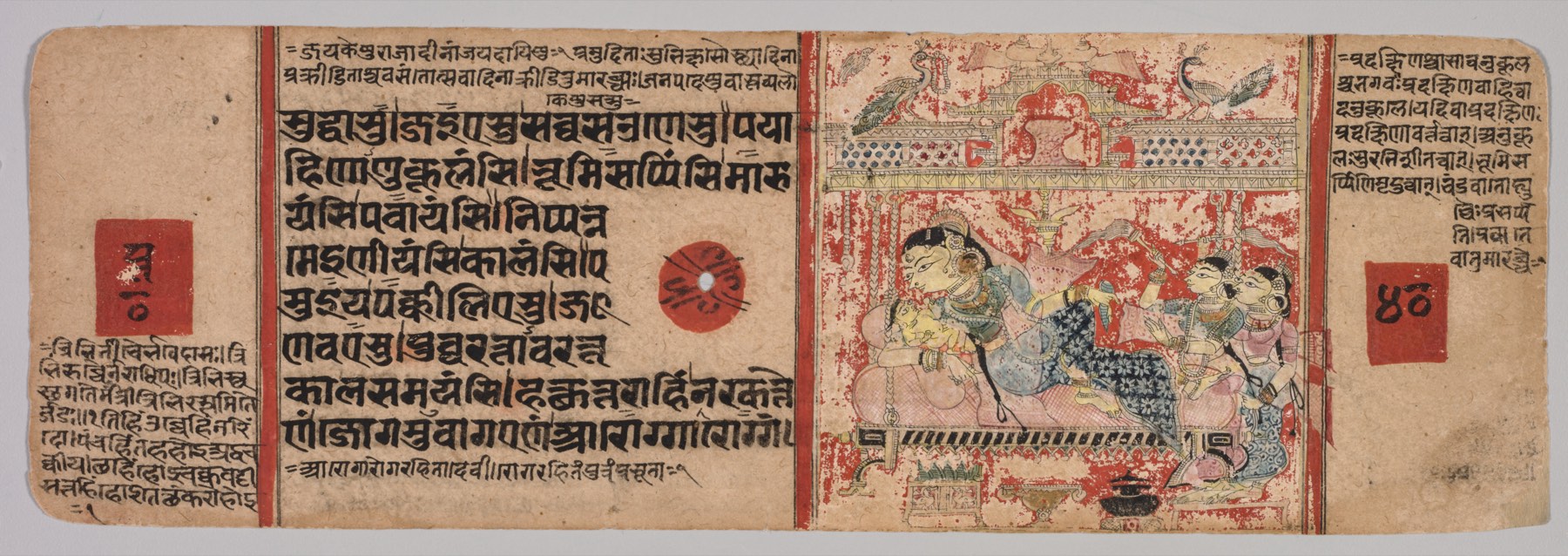
The Kalpa Sutra
Read aloud every Paryushan for some two thousand years, the Kalpa Sutra carries the lives of the Tirthankaras — above all the birth, renunciation, omniscience and nirvana of Mahaveer. Its illuminated manuscripts, painted in gold and lapis across western India, are among the treasures of world art.
On the festival's fifth day, the fourteen dreams of Trishala are displayed to the congregation — the same dreams a queen saw twenty-six centuries ago, still announcing the same birth.
See the Manuscript PaintingsCarry One Practice Home
A festival ends; a mantra continues. Keep the Navkar with you through the year, one bead at a time.
Open the Mantras