Who Is Mahaveer?
A prince who renounced everything, a seeker who endured everything, a teacher who excluded no one — the Great Hero who completed the line of the twenty-four Tirthankaras.
The Prince Named “Ever-Growing”
Around the sixth century BCE — tradition gives the year 599 BCE — a son was born to King Siddhartha and Queen Trishala of the Jnatrika clan, at Kshatriyakund near Vaishali, in present-day Bihar. While he was in the womb, the kingdom's harvests, treasury and happiness all swelled, so the child was named Vardhamana — “the ever-growing one.” Before his birth, Queen Trishala beheld a sequence of auspicious dreams — a lion, an elephant, the rising sun, a lake of lotuses among them — which the dream-readers said foretold a soul who would become either a universal emperor or a Tirthankara.
He became something greater than an emperor. The scriptures remember the young Vardhamana as fearless — the boy who calmly lifted away a serpent that scattered his playmates — yet inwardly untouched by the pleasures of the palace. He saw what most of us spend a lifetime not seeing: that everything gathered is eventually scattered, everything born must die, and that no kingdom can protect the soul from its own karma.
The Great Renunciation
At the age of thirty, after the passing of his parents and with the blessing of his elder brother, Vardhamana gave away his wealth, left the palace, plucked out his hair in five handfuls beneath an Ashoka tree, and walked into homelessness with nothing — not a bowl, not a garment, not a plan except one: to conquer himself completely.
For twelve and a half years he wandered in silence, mostly fasting, mostly standing in motionless meditation. He endured heat, cold, hunger, insect bites, abuse and assault without a flicker of anger — the texts say he did not so much as wish discomfort upon those who tormented him. Because he moved through every hardship unconquered, the world began to call him Mahaveer — the Great Hero.
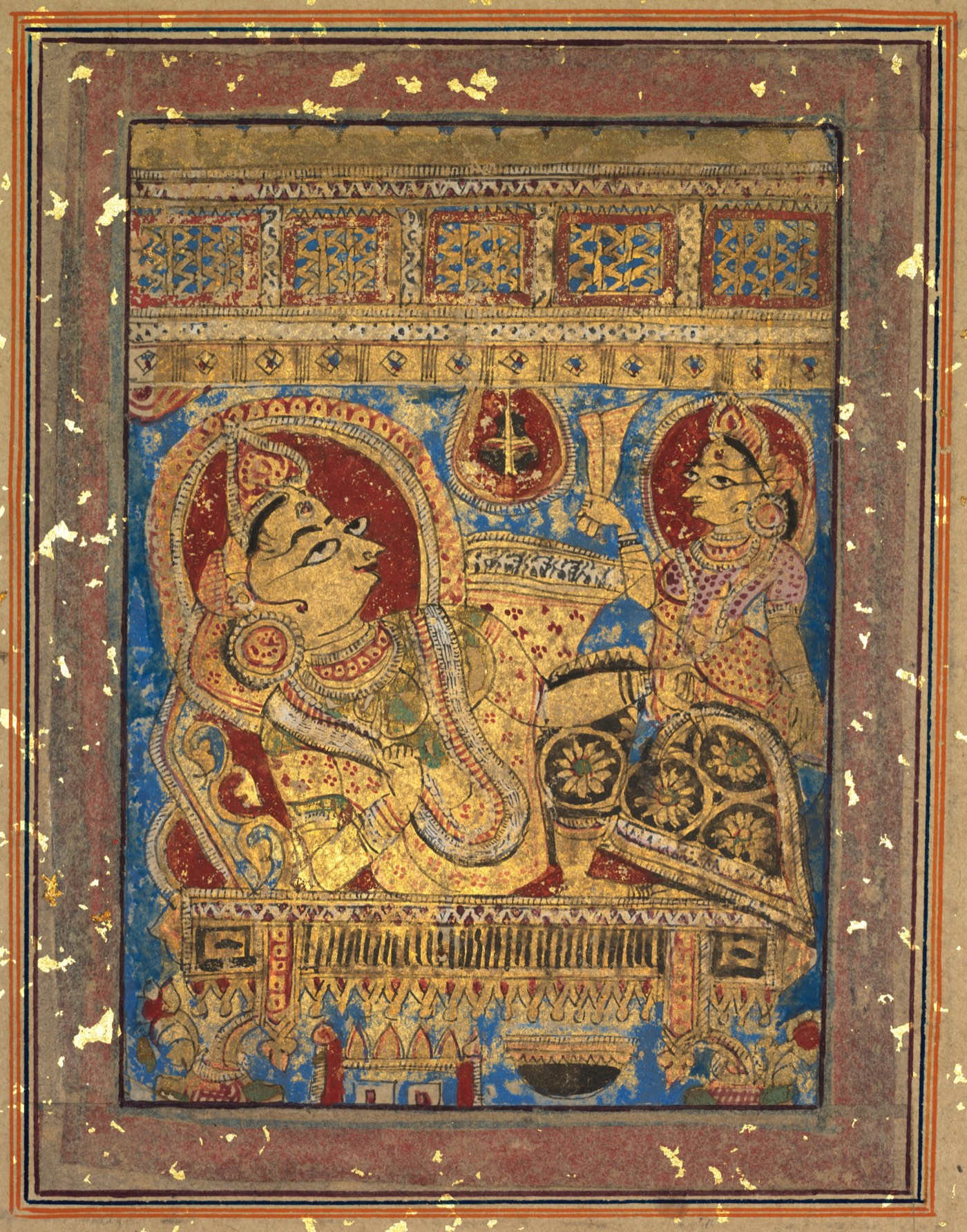
A Mother's Vision of a Tirthankara
On the night of his conception, Queen Trishala dreamt the great sequence of auspicious visions — among them a white elephant, a majestic bull, a lion, the goddess Lakshmi, garlands of flowers, the full moon, the rising sun, a golden vessel, a lake of lotuses and a smokeless fire.
The royal interpreters read them at once: the soul taking birth would illuminate the three worlds. In Jain homes these fourteen (sixteen, in the Digambara counting) dreams are still celebrated and re-enacted every Paryushan.
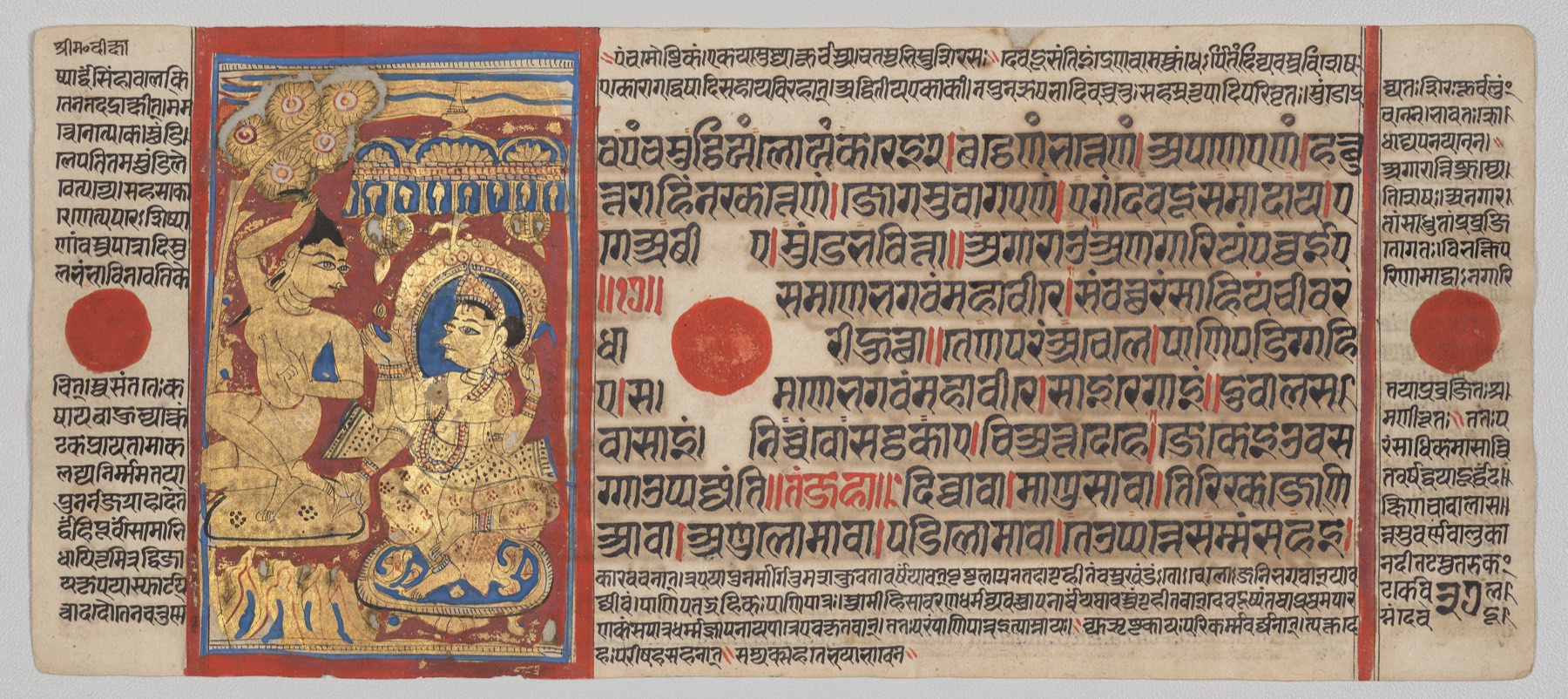
The Five Handfuls
Beneath an Ashoka tree, the prince removed his ornaments and plucked out his hair in five handfuls — the panch-mushti loch that Jain ascetics repeat to this day. The texts say Indra himself received the locks in his cupped hands.
This folio, painted in western India around 1475, shows the moment of the initiation tonsure — gold leaf for the bodies, lapis for the sky, and a king becoming a beggar of his own free will.
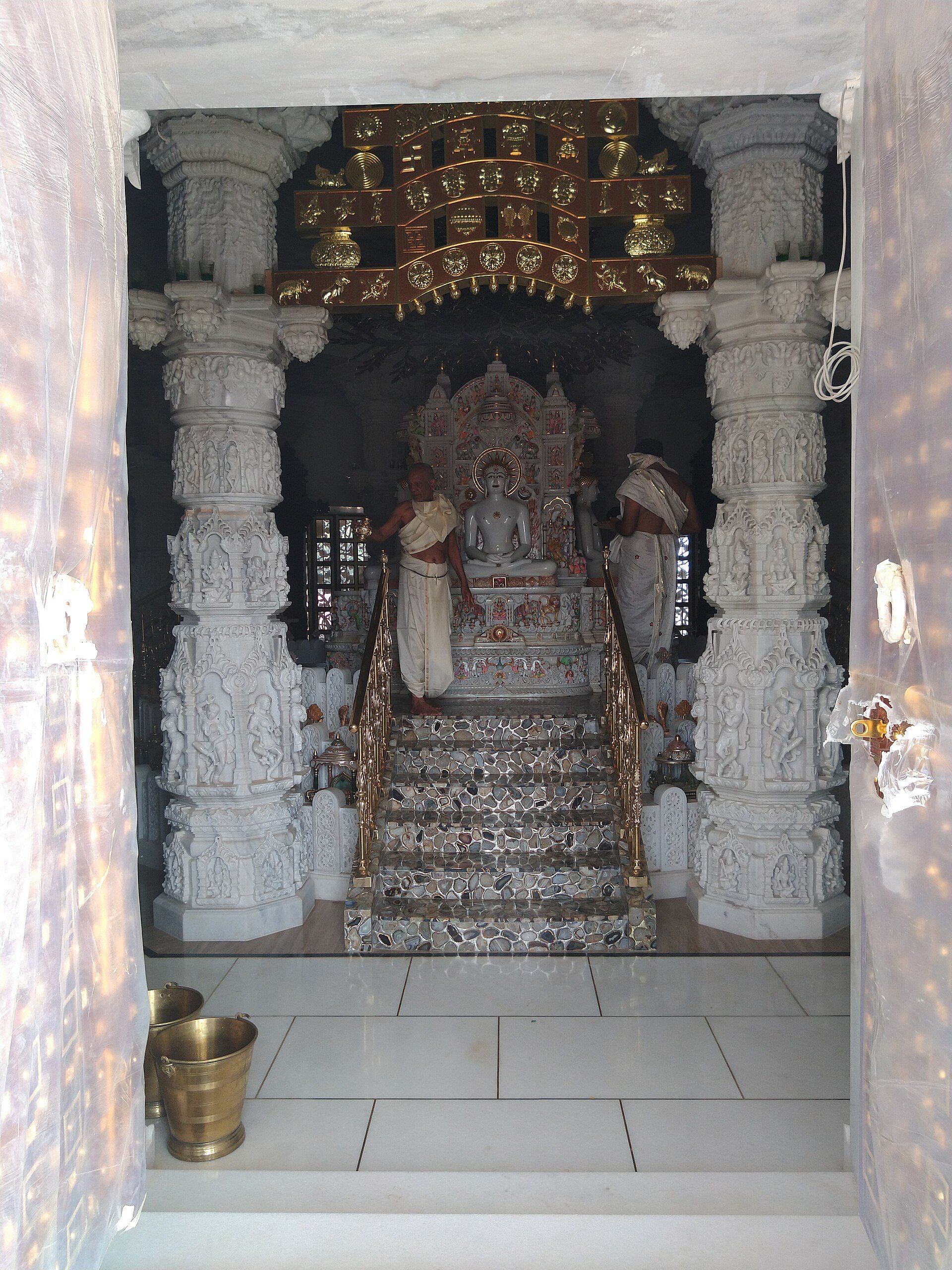
Omniscience on the Riverbank
In the thirteenth year of his austerities, seated in deep meditation under a sal tree on the bank of the river Rijubalika, the last veils of karma dissolved. Vardhamana attained kevala jnana — complete, unobstructed knowledge of all substances and all their modes, past, present and future. He was now a Jina: a conqueror.
A temple at Jrimbhikagrama (near present-day Jamui, Bihar) marks the spot where the prince who owned nothing came to know everything.
Thirty Years of Teaching
For the next thirty years Mahaveer walked across the Gangetic plains, teaching in Ardhamagadhi, the language of the people rather than of the scholars. In his samavasarana — the divine assembly the gods are said to have raised wherever he preached — humans, animals and celestial beings sat in concentric circles, each hearing the teaching in their own tongue. He organised his followers into the fourfold order that still stands: monks, nuns, laymen and laywomen, with eleven chief disciples (ganadharas) led by Indrabhuti Gautama.
“As you do not wish pain for yourself, do not inflict it on another. This is the whole of the dharma — the rest is commentary upon it.”
At the age of seventy-two, at Pawapuri, he delivered his final discourse — lasting, tradition says, forty-eight unbroken hours — and on the new-moon night of Kartik attained moksha, complete liberation. The lamps lit that night are remembered every year as Diwali.
The Five Great Vows
Mahaveer distilled the path into five vows — absolute for ascetics (mahavrata), practised in measure by householders (anuvrata).
Ahimsa — Non-violence
To harm no living being by act, word or thought — nor to cause harm, nor consent to it. Every soul, from human to the one-sensed beings of earth and water, is equal in its wish to live.
Satya — Truth
To speak only what is true — and only what is kind. A truth that wounds without need is itself a form of violence; silence is better than a harmful truth.
Asteya — Non-stealing
To take nothing that is not freely given — not an object, not credit, not time. Even a blade of grass belongs to someone, were it only the earth.
Brahmacharya — Chastity
Restraint of the senses and continence — for the ascetic, complete celibacy; for the householder, faithfulness — so the soul's energy turns inward instead of leaking outward.
Aparigraha — Non-possession
To limit and finally release all possessions and possessiveness. Attachment, Mahaveer taught, is subtler than ownership: one can renounce the object and keep the clinging.
The Three Jewels
The path to liberation, said Mahaveer, is walked on three feet together — none reaches the goal alone.
सम्यक् दर्शन
Right Faith
Seeing reality as it is — the soul as distinct from the body, karma as cause, liberation as possible. Not belief taken on authority, but conviction born of clear seeing.
सम्यक् ज्ञान
Right Knowledge
Knowledge of the tattvas — soul and non-soul, the inflow, binding, stopping and shedding of karma — free of doubt, error and vagueness.
सम्यक् चारित्र
Right Conduct
Living what is seen and known — the five vows, carefulness in walking, speaking, eating, placing and disposing, so that no being is harmed by inattention.
Anekantavada — The Many-Sided Truth
Mahaveer's subtlest gift to the world may be anekantavada, the doctrine that reality is many-sided and no single statement can exhaust it. Six blind men, the famous parable goes, touch an elephant: one finds a pillar, one a fan, one a rope, one a wall — each truthful, each incomplete. Wisdom is not choosing the winning description; it is knowing every description is partial.
From it flows syadvada, the discipline of conditioned assertion — the honest “from one point of view…” that disarms dogma before it can become cruelty. In an age of hardened certainties, the Great Hero's deepest non-violence may be this: ahimsa of the intellect.
The Lineage He Completed
Mahaveer was not the founder of Jainism but the last of twenty-four Tirthankaras — ford-makers who appear age after age to show the crossing.
Meet the 24 Tirthankaras