The 24 Tirthankaras
A Tirthankara is a “ford-maker” — a soul who crosses the river of existence and leaves a crossing behind for all others. Twenty-four arise in every great cycle of time.
Jainism does not begin with Mahaveer. He is the last of twenty-four Tirthankaras of the present descending half-cycle of time, each of whom rediscovered the same eternal dharma and re-established the fourfold order of monks, nuns, laymen and laywomen. The first, Rishabhanatha, belongs to remote prehistory; the 23rd, Parshvanatha, lived some 250 years before Mahaveer and is firmly historical. Each Tirthankara is identified by an emblem (lanchhana) carved beneath his image — Mahaveer's is the lion.
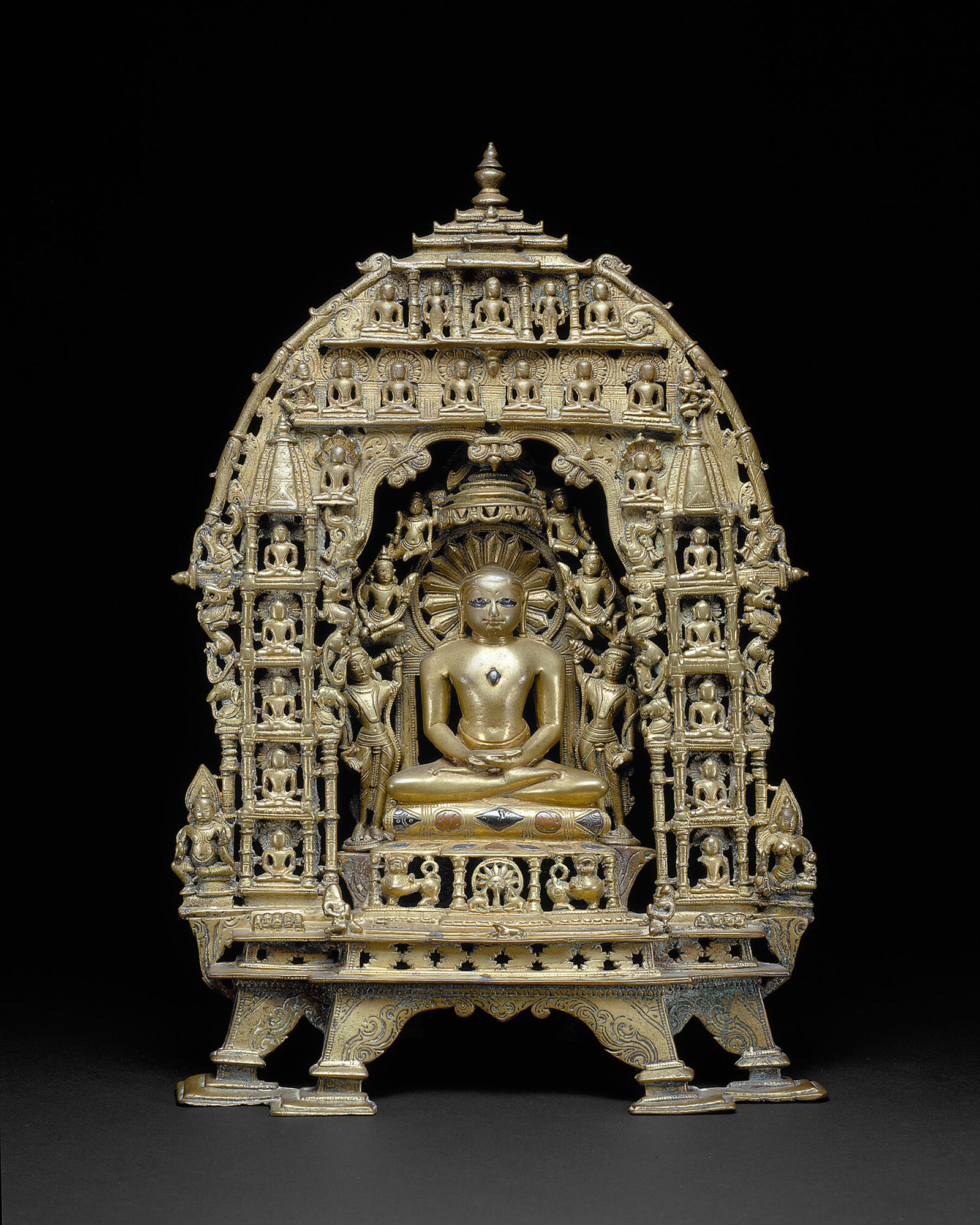
One Lineage, Cast in Bronze
Jain art loves to show the whole lineage at once — the chaubisi, all twenty-four together. In this altarpiece, cast in 1089 CE, the first Tirthankara Rishabhanatha sits enthroned while the other Jinas rise around him in a flame-shaped arch.
Whoever the central figure, the message is the same: the ford has been made again and again, and will be made again.
Rishabhanatha (Adinatha)
Emblem: Bull
The first Tirthankara, who taught humanity agriculture, crafts and writing before renouncing all of it. Attained moksha on Mount Kailash (Ashtapada).
Ajitanatha
Emblem: Elephant
“The Unconquered” — born in Ayodhya, he is invoked when fear and obstacles crowd the path.
Sambhavanatha
Emblem: Horse
Born at Shravasti; his teaching emphasised the rarity and preciousness of human birth.
Abhinandananatha
Emblem: Monkey
“The One Who Gladdens” — his very presence, the texts say, made beings rejoice.
Sumatinatha
Emblem: Krauncha bird
Lord of right wisdom, famed for resolving disputes with discernment even as a child.
Padmaprabha
Emblem: Red lotus
“Radiance of the Lotus” — his body is described as glowing like a red lotus at dawn.
Suparshvanatha
Emblem: Swastika
Born at Varanasi; the ancient symbol of well-being beneath his image marks the four destinies of the soul.
Chandraprabha
Emblem: Crescent moon
“Moonlight” — cool, luminous serenity; his temple at Sonagiri remains a great Digambara tirtha.
Pushpadanta (Suvidhinatha)
Emblem: Crocodile
Lord of right procedure — the careful, methodical practice that keeps the path from becoming theory.
Shitalanatha
Emblem: Shrivatsa / wishing tree
“The Cooling One” — his name itself a balm; remembered for stilling the fevers of body and mind.
Shreyansanatha
Emblem: Rhinoceros
“The Beneficial” — born at Simhapuri near Varanasi; his age saw the dharma flower again after long decline.
Vasupujya
Emblem: Buffalo
Attained moksha at Champapuri — the only Tirthankara whose all five kalyanakas occurred in one city.
Vimalanatha
Emblem: Boar
“The Stainless” — purity of perception, the mirror wiped clean of every distortion.
Anantanatha
Emblem: Falcon
“The Infinite” — pointing to the soul's endless knowledge, perception, bliss and energy.
Dharmanatha
Emblem: Vajra
Lord of dharma itself; the thunderbolt beneath his image is the unbreakable law.
Shantinatha
Emblem: Deer
Lord of peace — a chakravartin emperor who renounced the world's largest empire. Invoked wherever conflict needs cooling.
Kunthunatha
Emblem: Goat
Also an emperor before renunciation; his name is linked to compassion for the smallest creatures (kunthu).
Aranatha
Emblem: Nandyavarta
The third of the emperor-Tirthankaras; the auspicious nandyavarta diagram marks his seat.
Mallinatha
Emblem: Water pot (kalasha)
In the Shvetambara tradition, a woman — Princess Malli — whose beauty taught six kings the vanity of the body and the gloriousness of the soul.
Munisuvrata
Emblem: Tortoise
Tirthankara of the age of Rama; the tortoise — steady, withdrawn into itself — is his perfect sign.
Naminatha
Emblem: Blue lotus
Born at Mithila; kings besieging the city bowed instead, the texts say, the moment he was conceived.
Neminatha (Arishtanemi)
Emblem: Conch
Cousin of Lord Krishna. Hearing the cries of animals penned for his wedding feast, he turned his chariot around and renounced the world on the spot — attaining moksha on Mount Girnar.
Parshvanatha
Emblem: Serpent
The beloved historical Tirthankara of Varanasi (c. 9th–8th century BCE), sheltered by the serpent king Dharanendra. His fourfold restraint preceded Mahaveer's five vows.
Mahaveer (Vardhamana)
Emblem: Lion
The Great Hero of Kshatriyakund — who reorganised the eternal dharma for our age and attained nirvana at Pawapuri. Read his full story →
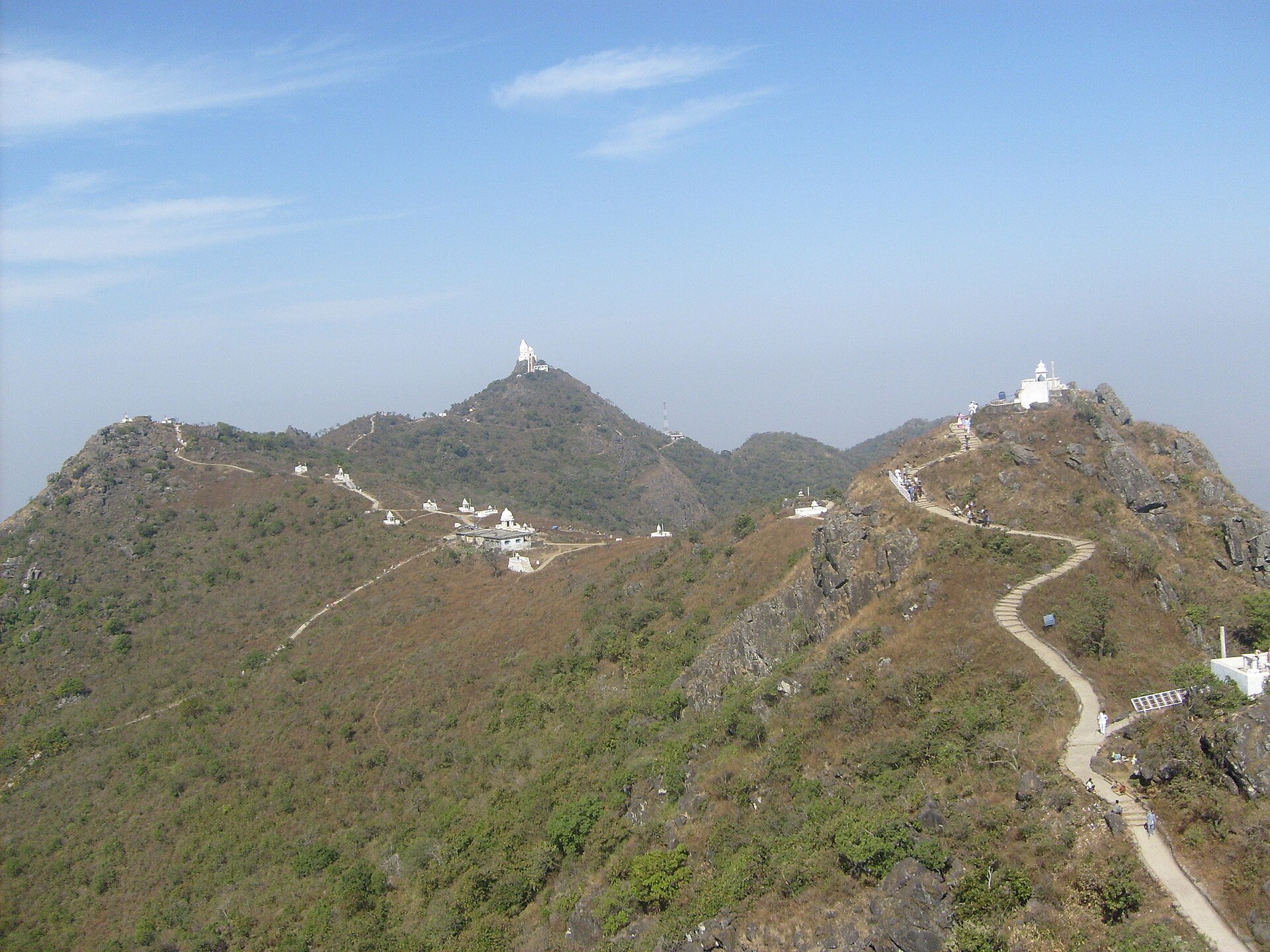
Shikharji — Where Twenty Crossed Over
Of the twenty-four Tirthankaras, twenty attained moksha on Shikharji — Parasnath hill in Jharkhand, named for Parshvanatha, the highest mountain of the region. Pilgrims walk its 27-kilometre parikrama barefoot, bowing at the tonk of each Tirthankara along the ridge.
The other great crossings: Rishabhanatha on Kailash, Vasupujya at Champapuri, Neminatha on Girnar — and Mahaveer at Pawapuri, where the lotus lake now holds the Jal Mandir.
See the Sacred PlacesThe Festivals That Remember Them
Every kalyanaka — birth, renunciation, omniscience, liberation — is still celebrated, from Mahavir Jayanti to the lamps of Diwali.
Explore the Festivals